Popular Spanish Structures for Everyday Conversation
1. The If Conditional
Conditional sentences mapping dependencies function similarly to simple programming statements. If the condition occurs, the output action triggers immediately.
Example 1: Si estudias, pasarás el examen.
(If you study, you will pass the exam.)
Example 2: Si tengo tiempo, te llamo hoy.
(If I have time, I'll call you today.)
💡 Pro-Tip
Avoid using the subjunctive mood immediately after "si" when dealing with highly probable, real-life everyday conditional parameters.

2. Hace to denote time since
Placed at the beginning of a statement, Hace translates literally to "It makes," serving to establish the exact duration that has accumulated since a past event occurred.
Example 1: Hace dos años que vivo en esta ciudad.
(It has been two years since I started living in this city.)
Example 2: Hace tres horas que terminó la película.
(The movie finished three hours ago.)
💡 Pro-Tip
Think of it as reading chronologically from left to right: "It makes [X hours] that [Y event happened]."

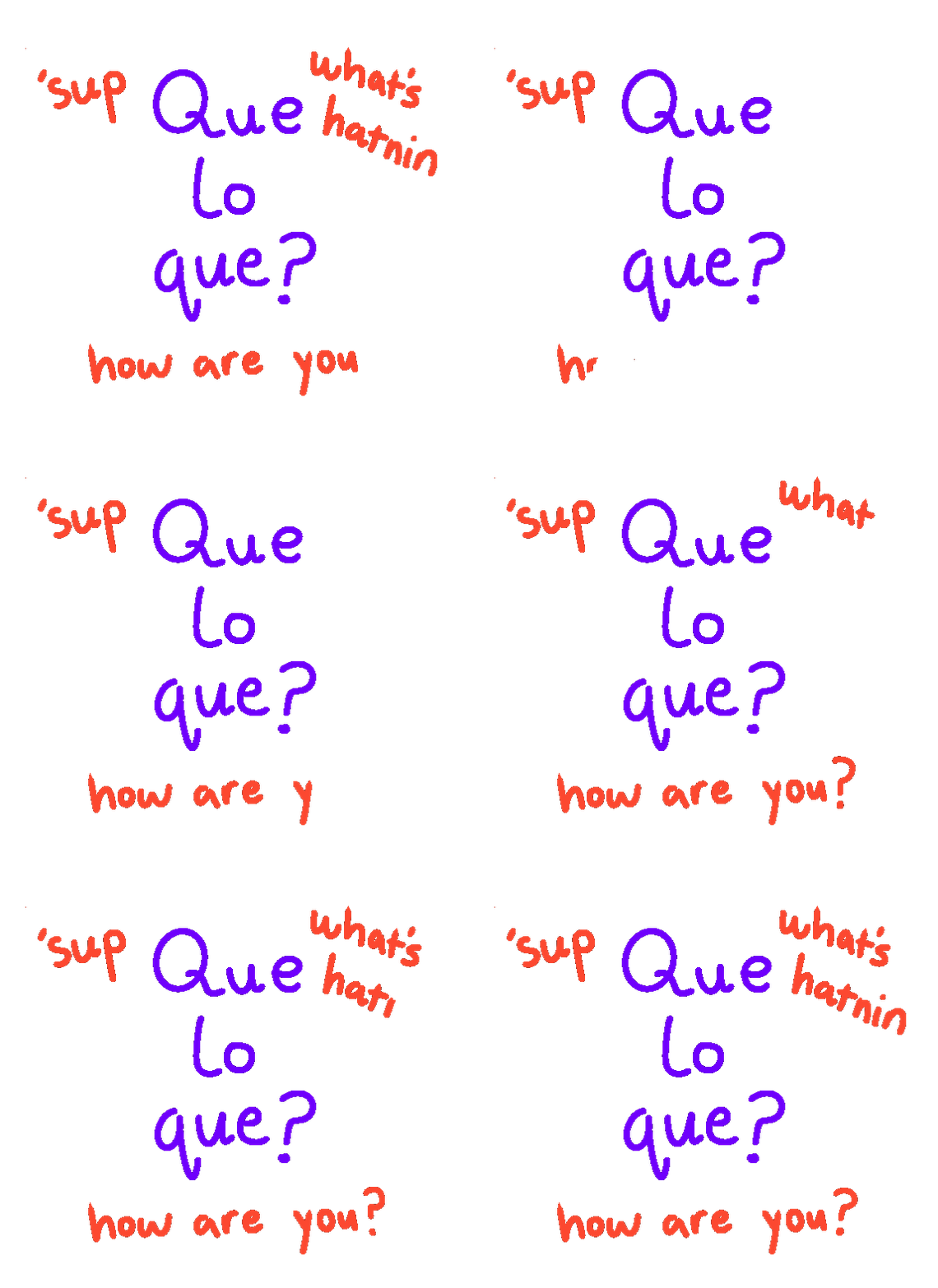
3. What's What ¿Qué lo qué?
Highly popular across Caribbean communities, particularly the Dominican Republic, this phrase compiles three literal connector particles into a rapid conversational colloquialism greeting.
Example 1: ¡Dime, hermano! ¿Qué lo qué?
(Tell me, brother! What's up?)
Example 2: No entiendo qué lo qué con esta situación.
(I don't understand what's what with this situation.)
💡 Pro-Tip
While originally slang, it can also function within standard structures to cleanly express the core substance of a complex dynamic entity.
4. Se as Impersonal
While 1st person uses me and 2nd person uses te, the particle se strips explicit personal identity away, focusing attention entirely on the verb action itself.
Example 1: ¿Cómo se dice 'rice' en español?
(How does one say 'rice' in Spanish?)
Example 2: Aquí se habla español.
(Spanish is spoken here.)
💡 Pro-Tip
Use this structure when the identity of the person performing the action is irrelevant or general knowledge.
5. Que as "That"
Whenever a sentence chains consecutive verb matrices that belong to two different subjects, Spanish requires an explicit que bridge operator to cleanly divide the actions.
Comments